0242-2002-555
 contact@scsglobalaudit.vn

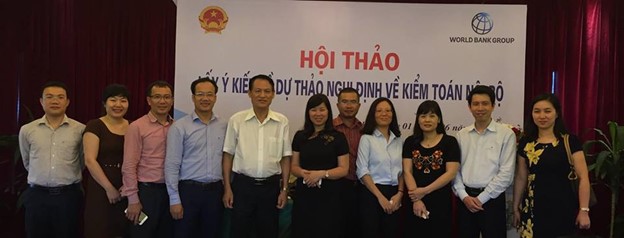
Decree 05/2019/ND-CP regulates internal audit activities in state agencies, public non-business units, and enterprises, and has been effective since April 1, 2019. Decree 05 provides a legal framework for organizing and conducting internal audits as well as regulations on the standards of the internal audit department.
Requirements of an internal auditor
According to Decree 05, enterprises are required to carry out internal audit (IA) work, including: listed companies; enterprises in which the state owns more than 50% of the charter capital that are parent companies operating under the parent-subsidiary model; state-owned enterprises that are parent companies operating under the parent-subsidiary model. The decree also encourages other enterprises to carry out internal audit work.
Accordingly, persons performing internal audit tasks must meet the following standards:
– Have a university degree or higher in a major relevant to auditing requirements, with sufficient knowledge and always updated on the areas assigned for internal audit.
– Have at least 5 years of work experience in the trained major, or at least 3 years of work experience in the current unit, or at least 3 years as an auditor, accountant, or inspector.
– Have not been disciplined at the warning level or higher due to violations in economic, financial, or accounting management, and are not currently undergoing disciplinary enforcement.
– Have knowledge and general understanding of the law and the operations of the unit; have the ability to collect, analyze, evaluate, and synthesize information; have knowledge and skills in internal auditing.
The decree also clearly stipulates requirements to ensure compliance with the basic principles of internal auditing, such as: Individuals performing internal audit work must have a fair, objective, and unbiased attitude.
Individuals performing internal audit work have the right and obligation to report issues that may affect their independence and objectivity related to the assigned internal audit tasks.
The internal auditor must ensure independence and objectivity. In case the independence or objectivity is affected or may be affected, the internal auditor must report to the direct management or to the subjects specified in Clause 4, Article 12 of this Decree or the authorized persons of the subjects specified in Clause 4, Article 12 of this Decree
.In internal audit, the unit must implement the following regulations to ensure independence and objectivity, prevent unfairness, prejudice and conflicts of interest.
The problem of qualified human resources
According to Mr. Hoang Hung, Deputy General Director of PwC Vietnam and former international consultant supporting the development of Decree 05, the issue of internal audit personnel will be one of the main problems that businesses will have to address, because the number of personnel with full competence, experience, and professional qualifications in internal audit on the labor market is very limited.In this context, the training program ‘International Standard Internal Audit – CPIA’ developed by AFA Research & Education is currently the first and only program that ensures high practicality according to international standards for Internal Audit. The program belongs to the Institute of Management Accountants of Australia (CMA Australia) and is awarded the ‘CPIA – Certificate of Proficiency in Internal Audit’ certification. The International Standard Internal Audit – CPIA program aims to standardize knowledge, share years of consulting and internal audit experience from experts, with a framework program according to international standards (IPPF) issued by the Institute of Internal Auditors (IIA).The program consists of 3 modules, each module including 4 parts based on the international internal audit framework, combined with sections sharing practical experience from internal audit experts in various industries. The program is designed with practical case studies for each session so that learners can immediately get into the internal audit profession. Mr. Nguyễn Đăng Toàn – ATC Auditing and Valuation Company Limited stated: “Internal auditing is truly a very difficult field, so I wanted to get exposure to real case studies. In the CPIA program, the instructors all have deep experience and are willing to share it, so I have learned a lot.”How to build an internal audit team
The issue of internal audit (IA) personnel will be one of the main issues that businesses must address. The reason is that the number of personnel with full competence, experience, and professional qualifications in IA in the labor market is very limited.
Participating in the training program “International Standard Internal Audit – CPIA” developed by AFA Research & Education is one of the most practical ways to build a quality human resource pool for the internal audit department.
Especially in 2019, AFA Research & Education purchased the copyright for the famous training film “False Assurance” (Audit Misconduct) produced by the Institute of Chartered Accountants in England and Wales (ICAEW) to integrate into the international standard Internal Audit training program (CPIA). The film is subtitled in Vietnamese with many real-life situations, which will help learners have the most realistic view of the work of internal auditors.